
Your Third Shot Isn’t a Technique Problem. It’s a Reading Problem.
Three drills to help you read the ball, choose the right response, and stop turning perfect setups into wasted opportunities.

Sunday morning clinic. Live-point drills. A student named Sarah who’d been struggling with consistency.
She’d just hit the best return of the session — deep, low, a little topspin, right to the server’s backhand corner. The serving team was pushed back. Their third shot floated up high and slow, right in the middle of the court.
Sarah was already at the kitchen line, paddle ready.
She tried to blast a winner down the line. The ball sailed two feet long.
I pulled her aside: “You earned a free third shot with that return. When the ball is that high and slow, you don’t need to crush it — just redirect it.”
Two points later, same situation. Same beautiful return. Same floating third shot from the opponents.
This time, Sarah opened her paddle face and dropped a soft angle into their kitchen. It died right at their feet. Point over.
Same setup. Completely different result. The only thing that changed was what she decided to do with the gift.
Here’s how to train the decision — and the mistakes that get in the way.
The Drills
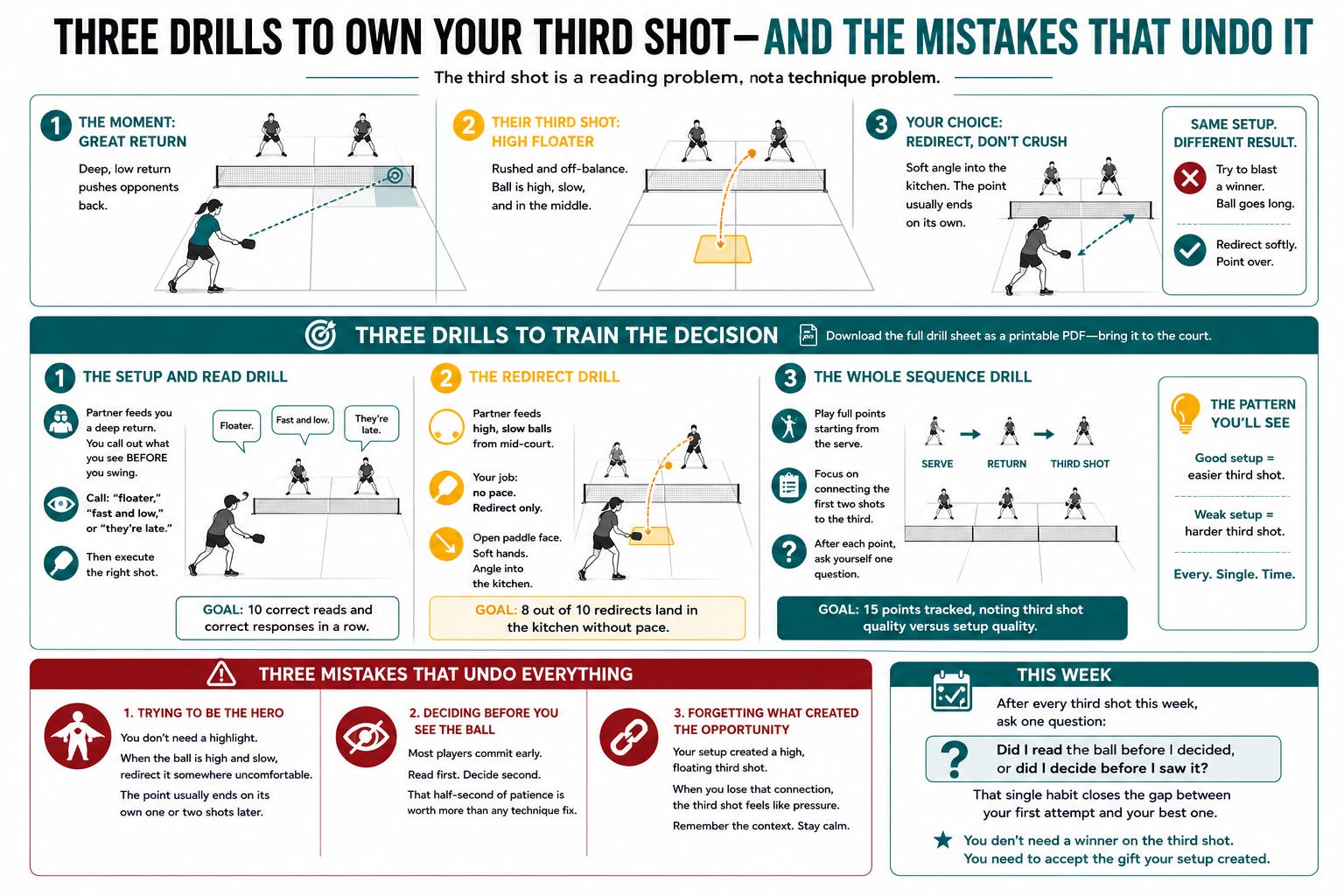
Three drills. All built around one principle: the third shot is a reading problem, not a technique problem.
Download the full drill sheet as a printable PDF — bring it to the court.
Drill 1: The Setup and Read Drill
Partner feeds you a deep return from the baseline. You play the third shot — but before you swing, you must call out what you see: “floater,” “fast and low,” or “they’re late.” Then execute accordingly.
Goal: 10 consecutive correct reads and responses.
This drill forces the habit Sunday’s article described — see the ball first, decide second. Most players skip the read entirely and commit to a shot before the ball arrives. Calling it out loud breaks that habit.
Drill 2: The Redirect Drill
Partner feeds high, slow balls from mid-court — simulating the floater that good setup produces. Your job: no pace. Redirect only. Open paddle face, soft hands, angle it into the kitchen.
Goal: 8 out of 10 redirects land in the kitchen without pace.
This is the drill Sarah needed. The instinct on a high ball is to attack. This trains the opposite — control over power, redirect over crush.
Drill 3: The Whole Sequence Drill
Play out full points starting from the serve. Your only focus: connect the first two shots to the third. After each point, ask yourself one question — did my serve or return make my third shot easier or harder?
Goal: 15 points tracked, noting third shot quality versus setup quality.
You’ll see the pattern within one session. Good setup, easier third shot. Weak setup, harder third shot. Every time.
The Mistakes
Three mistakes that undo everything Sunday taught.
Trying to be the hero. Sarah’s first attempt was the clearest version of this mistake I’ve ever seen in a clinic. The setup was perfect. The opportunity was obvious. And she tried to do more than the situation required. When the ball is high and slow, your job isn’t to end the point dramatically — it’s to redirect it somewhere uncomfortable. The point usually ends on its own, one or two shots later.
Deciding before you see the ball. Most players commit to a drop or a drive before their opponent even makes contact on shot two. They’ve already decided. Then the ball arrives and doesn’t match the plan — and they execute the wrong shot anyway because the decision was already made. Read first. Decide second. That half-second of patience is worth more than any adjustment to technique.
Forgetting what created the opportunity. Sarah’s botched attempt happened partly because she stopped thinking about her return and started thinking about the put-away. The connection broke. When you lose track of the setup, the third shot feels like pressure rather than an opportunity. Remember: a high floating third shot didn’t appear by accident. Your return created it. That context keeps you calm.
This Week
You don’t need a winner on the third shot. You need to accept the gift your setup created.
✓ After every third shot this week, ask one question: did I read the ball before I decided, or did I decide before I saw it? That single habit closes the gap between Sarah’s first attempt and her second.
See you Sunday.
Bob
Share it with a pickleball friend who will benefit.
Ask a question or share your thoughts in the comments.
Thanks for reading Elevate Your Pickleball Game - One Skill At A Time!
Subscribe for free to receive new posts and support my work.